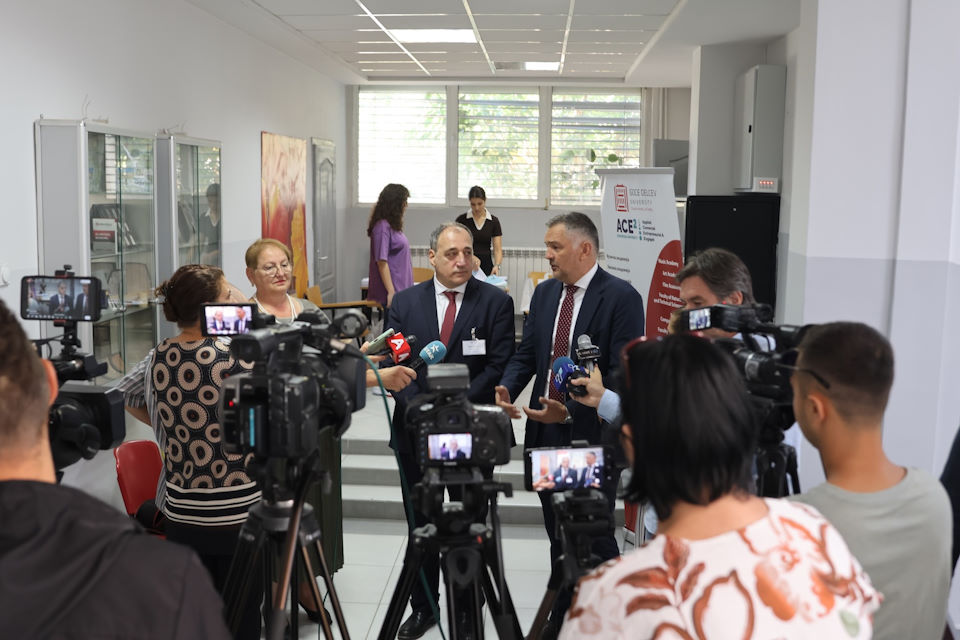
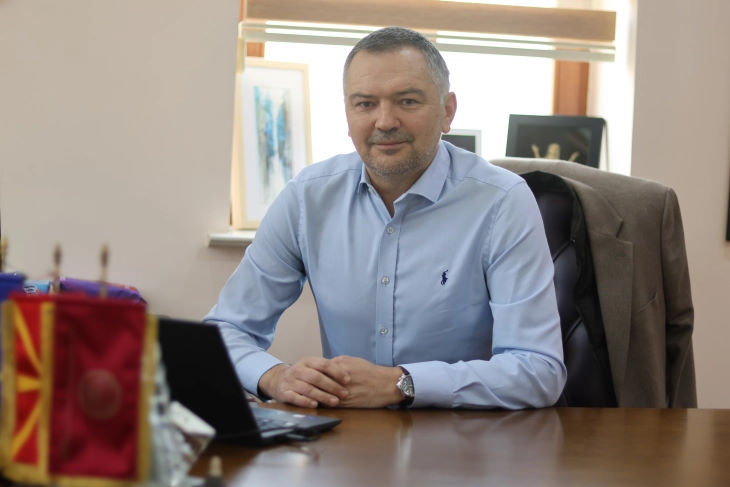
“This year, the ‘Goce Delcev’ University in Stip will implement projects that have a direct impact on students and teaching staff, as well as investments that will position the University as a stable and recognizable scientific research and educational center at the national and even regional level,” said the rector of the University, Dejan Mirakovski, in an interview with MIA.
He points out that the activities for the construction of a new building for the Faculty of Medical Sciences and for the Student Dormitory are in an advanced phase of technical analysis and preparation of project documentation, which are being implemented in accordance with all legal and administrative procedures.
Mirakovski emphasizes that the participation of the UGD-Stip in the European Alliance of Universities ACE²EU, which includes nine European universities, allows students to acquire knowledge and competencies that are in demand on our, but also on the European labor market, as well as to be an equal part of the European academic community.
The rector of the University of Georgia – Stip also said in an interview with MIA that in the context of the development of artificial intelligence and its adoption in education, the economy and everyday life, the goal and role of higher education institutions is to prepare students to use technology as a support in learning, research and professional development, and not to be replaced by it, with human creativity, responsibility and critical thinking remaining key competencies.
Below is the full interview with Dejan Mirakovski, rector of the University “Goce Delcev” – Stip.
Rector Mirakovski, what are the priority projects of the University “Goce Delcev” – Stip in 2026?
– We see this 2026 as a year of consolidation and a qualitative leap forward. The priorities are clearly set in three basic directions: improving the infrastructure and conditions for studying, strengthening scientific and research capacities and deeper international integration.
The focus is on projects that have a direct impact on students and teaching staff, but also on investments that will position the University as a stable and recognizable research and educational center at the national and even regional level.
Currently, several research and application projects are being implemented, in cooperation with partner universities and the economy. The range is truly wide – from innovative technologies for monitoring water quality in almost real time, to the development of new analytical and digital tools in medicine. The public will be informed about the results in a timely manner after the activities are completed.
An investment in a new building for the Faculty of Medical Sciences and a Student Dormitory has been announced for 2025. How far along is the entire procedure and when will the implementation of these two projects begin?
– These two projects represent key infrastructure investments for the University. The procedures are under the jurisdiction of the Ministry of Education and Science and the Government, and according to the information we have, these activities are in an advanced phase of technical analysis and preparation of project documentation, which are being implemented in accordance with all legal and administrative procedures.
The new building for the Faculty of Medical Sciences is designed as a modern educational and scientific space, with functional laboratories, multifunctional classrooms and advanced simulation facilities, which will significantly improve the quality of practical and theoretical teaching for future doctors.
The Student Dormitory project is aimed at providing dignified and modern living conditions, with a special emphasis on energy efficiency and compliance with standards appropriate to the needs of today’s students.
After completing the formal procedures, we expect the implementation to begin and we hope that during this year we will be able to see the first concrete results of these activities.
The University of Stip “Goce Delcev” is becoming more attractive for future students, because you are part of the European Alliance of Universities. What does this Alliance offer to future students?
– Membership in ACE²EU – the Alliance of Applied, Connected, Entrepreneurial and Engaged Universities opens up concrete and truly valuable development opportunities for students. The Alliance unites nine European universities and is part of the European University Alliances initiative, which is financially supported by the European Union with significant resources that enable extensive and sustainable implementation of all planned activities and projects, with the participation of a truly large number of students.
For students, this means access to joint international study programs, academic mobility, exchange and participation in activities such as summer schools, international competitions and joint projects. Through these activities, they develop innovative, entrepreneurial and interdisciplinary skills, aligned with European educational standards. The ultimate goal is for students to acquire knowledge and competencies that are in demand on our, but also on the European labor market, as well as to be an equal part of the European academic community. In other words, they gain European experience and knowledge while studying in Stip, and their knowledge and diplomas become recognized and more competitive not only at the national, but also at the European level.
Does membership in this Association also mean new investments and in what part?
– Yes, but these investments should not be viewed exclusively through the prism of classic infrastructure investments. The greatest added value is precisely in investments in knowledge, people and institutional capacities.
Membership enables greater participation in European projects, joint scientific research activities, modernization and equipping of laboratories through international funds, as well as continuous development of teaching and research staff. These are investments that generate long-term effects through improving the quality, competitiveness and international position of the University.
Although it is usual for the greatest effects of such collaborations to be valorized in the medium and long term, in the first year of membership we have already noticed a significant increase in international project cooperation and the initiation of a large number of joint educational and scientific research projects with partner universities, which is a clear indicator of the real value of the Alliance.
In your opinion, in what direction will universities develop, given that the world is already facing the challenge of artificial intelligence?
– Artificial intelligence is a major change that must be responsibly integrated and which will undoubtedly have a strong impact on the whole of society, including the way universities function. It certainly brings new opportunities, but also obligations for truly careful and ethical use.
In this context, I believe that the focus in higher education will gradually shift from the reproduction of information to the development of critical thinking, interdisciplinary approaches, analytical skills and practical application of knowledge.
Universities will need to create staff who know how to work with these advanced technologies, but at the same time understand their limitations and social implications.
Our role is to prepare students to use technology as a support in learning, research and professional development, and not to be replaced by it, with human creativity, responsibility and critical thought remaining key competencies.
The University of Stip is known for its scientific work, especially in the area of research at the AMBICON laboratory, and at the end of December you also opened the Circular Economy Laboratory. Will we have any news in the area of scientific research during 2026?
– Yes, and in several segments. After the opening of the Circular Economy Laboratory, during this year we continue to further expand and improve our research capacities, with a special focus on areas of strategic importance for the country and the region, such as sustainable development and the environment, medicine and pharmacy, the development of new materials and applied scientific disciplines.
In parallel, we are also working on new scientific research and application projects, in cooperation with partner universities and the economy, with the emphasis on interdisciplinary solutions and practical application of scientific results. Our focus is for science not to remain confined to laboratories, but to be directly connected to the real needs of society and industry, thereby contributing to sustainable development, innovation and improving the quality of life.
According to students, UGD is the most digitalized university in the country. Are you thinking of taking a step further in digitalization?
– Digitalization for us has never been a completed project, but a continuous process. The fact that students recognize the University “Goce Delcev” – Stip as the most digitalized university in the country confirms the direction we are moving in. Our ambition is not only to maintain that leadership, but also to further improve it.
For a long time, we have been working on developing a new integrated platform that will not only be a software solution, but a system that will enable a better user experience, smarter use of data, more efficient and direct communication with students and significantly simplified administrative procedures. Our goal is for the University to function quickly, transparently and service-oriented, with minimal bureaucracy, which is possible today only through advanced and well-designed digital tools.
In what direction should the development of higher education go?
The higher education of the future must be flexible, connected to the real sector and focused on quality, not quantity. Instead of formally fulfilling programs, it is necessary to create competent, independent and responsible young people. Universities should be the driver of social development, and not just formal institutions where a diploma is obtained.
Our goal is not for the University “Goce Delcev” – Stip to be the largest, but a relevant, engaged and responsible institution. A university that provides knowledge, but also direction to young people. A university that creates science that makes sense and education that has real value. That is why I believe that investments in higher education are investments in the future of the country, and we as a University have an obligation to build that future with quality, vision and integrity.