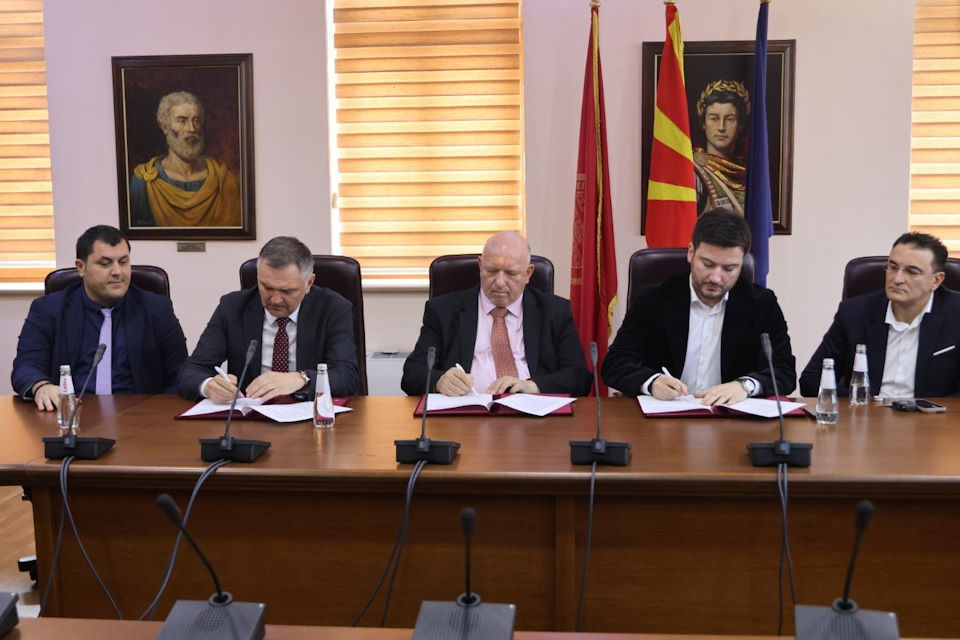
Goce Delcev University – Stip, the Chamber of Commerce of North Macedonia and the Municipality of Stip today signed an initiative to establish an Innovation Center in Stip, the aim of which is to encourage entrepreneurship among young people and to enable the development of new businesses with support from the university, local government and the business community.
The Rector of the University, Prof. Dr. Dejan Mirakovski, stressed that this is a joint effort of all relevant stakeholders in the region.
“This innovation center is a joint effort by the real sector, the economy, the local government and the companies from this region, together with the university, to create a bridge so that our students and professors can develop their ideas to the point of commercialization, contribute to real employment for future generations, contribute to the development of the economy in this region and have better chances for success both in terms of the economy and in terms of the quality of life in this region. Our students could really do businesses here that are competitive with anywhere in the world. That idea is noble to me and the discussion is really unnecessary when you have the opportunity for the real sector, together with the local government and the university, that is, the young people who are here, to open up space for them to develop as individuals, to make connections with the real economy and to create businesses from which they and their future employees can live, with better working conditions, higher salaries and greater development,” said Mirakovski.
The President of the Chamber of Commerce, Branko Azeski, emphasized that Shtip and the university are ready to participate in the process of transforming education in line with the needs of business.

“I personally believe that this cooperation with the municipality of Stip and the State University means that both the municipality and the university are ready to participate in that process better than all other municipalities and universities in the country. I can responsibly confirm this by saying that the Goce Delcev University from Stip is practically the first to follow all activities for the transformation of education in terms of the needs of business… What the Chamber of Commerce will do is to go beyond the borders of the country and, with the support of the economic investment forum based in Trieste, within the framework of the European Union, as a product of Chancellor Merkel’s plan to support the Western Balkans, as well as with project activities financed by the European Union, to enable programs for the municipality and the university that will contribute to their development with European funds,” Azeski emphasized.
The Mayor of Stip, Ivan Jordanov, pointed out that the initiative represents a step towards improving the conditions of the labor and capital market, as well as strengthening regional development.
“The goal is to help the capital and labor markets, in order to improve the opportunities for regional and local development. Stip as a regional center is a generator of regional development, and all other stakeholders are involved here. I believe that this initiative will create opportunities for opening new business ideas and new jobs, enabling young people to acquire appropriate skills and knowledge, but also greater utilization of national and European funds. A key factor will be the owners of capital, who I believe will be motivated to invest in new values and development,” said Jordanov.
Businessman Marijan Jofchevski assessed the initiative as the beginning of a process that should bring higher-quality personnel for the needs of the economy.
“For many years now, we have been seeing how we produce personnel that we need to consume in the future, but they are not of such high quality and end up in other countries as unqualified personnel. What business needs is communication and cooperation. This is the beginning of a great initiative and idea,” said Jofchevski.
The initiative opens up the possibility of establishing systemic cooperation between the academic community, local government and the business sector, with the aim of retaining young people in the region and creating competitive companies with the potential to enter the international market.