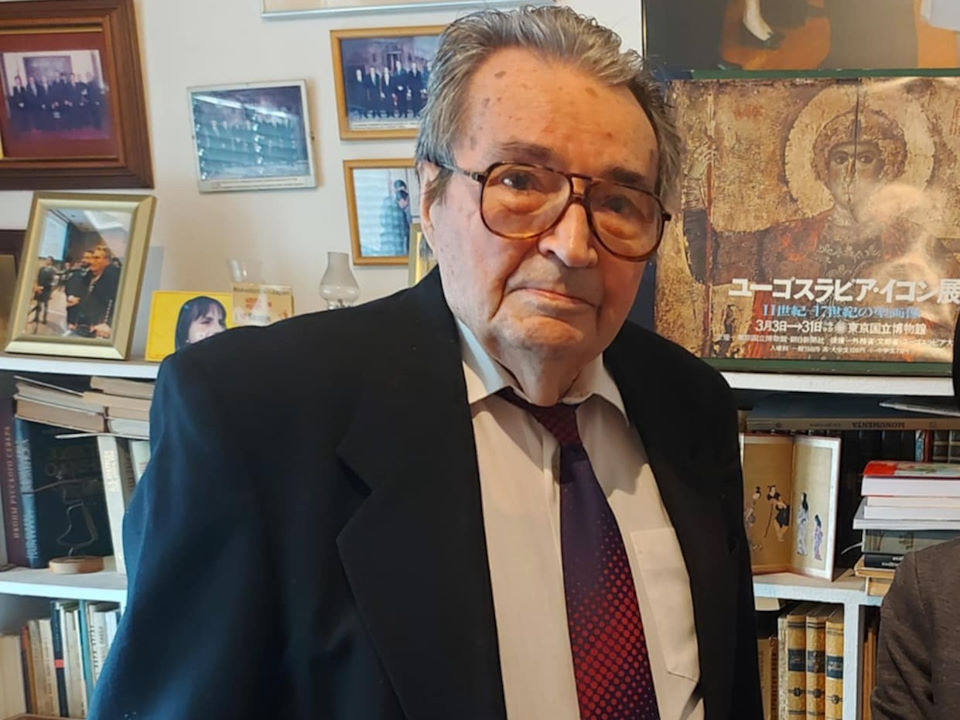
On February 6, 2026, Kosta Balabanov (1929–2026), a prominent art historian, conservator, film and television screenwriter and long-time honorary consul of Japan in Macedonia, passed away. His scientific and cultural work left a lasting mark on Macedonian culture and history. He published more than 200 professional and scientific papers and 24 books dedicated to medieval art, and during his career he recorded over 18,000 icons in more than 1,700 churches and monasteries, visiting over 1,340 settlements in Macedonia.
In addition to his significant contribution to the field of art and conservation, Balabanov actively participated in the civic initiative for the establishment of the “Goce Delcev” University in Stip. Already in the early 21st century, he played a key role in promoting the idea of opening a university in Eastern Macedonia, including public presentations and activities that affirmed the importance of higher education in the region.
Balabanov also worked on international projects. Since 1994, he was the first Honorary Consul General of Japan in Macedonia and Director of the Japan Information Center in Skopje. His collaboration with “Vardar Film” and MRTV resulted in 32 documentaries, often dubbed into foreign languages, that promoted archaeology and medieval art on the territory of Macedonia.
Kosta Balabanov’s contribution to science, art and higher education remains a significant part of the legacy of the “Goce Delcev” University, as well as a symbol of his dedication to the development of education and cultural awareness in Eastern Macedonia.
Balabanov was born on April 5, 1929 in Shtip. While still a student, in 1952, he began working at the then Central Institute for the Protection of Cultural Monuments as an assistant-preparator. From 1953 he worked there as an art historian-conservator. In 1955 he graduated in art history with archaeology from the Faculty of Philosophy in Skopje. After graduating, he continued to work at the Central, later the Republican Institute for the Protection of Cultural Monuments and Natural Rarities of Macedonia in Skopje, where he earned the title of trainee-conservator. In 1956, the Federal Institute for the Protection of Cultural Monuments in Belgrade sent him to specialize in Vienna, at the Conservation Center (Bundesdek – malamt).