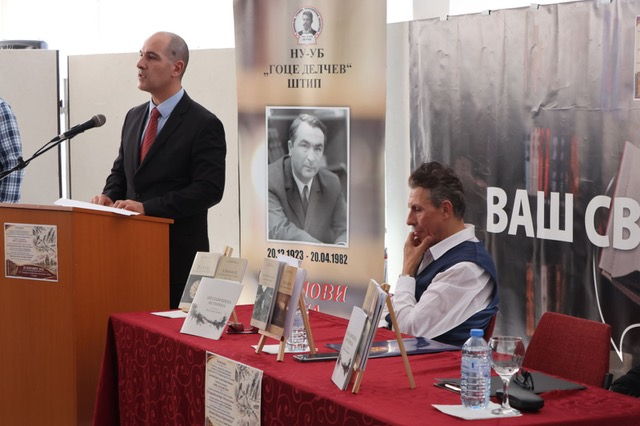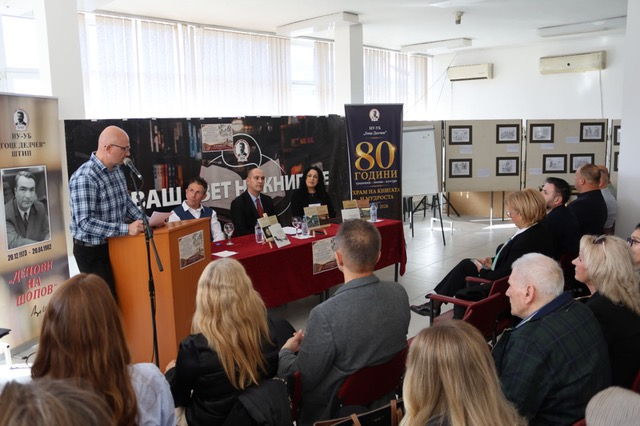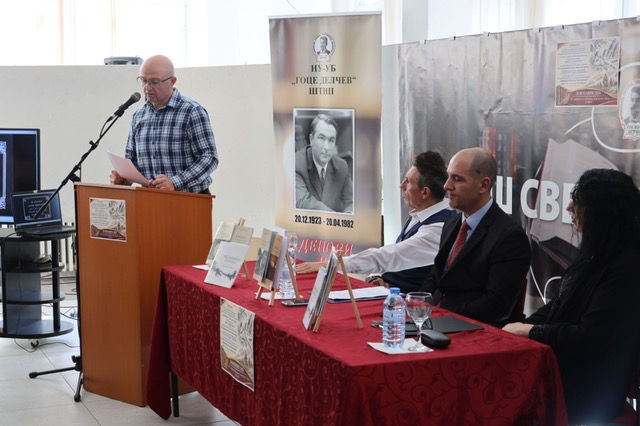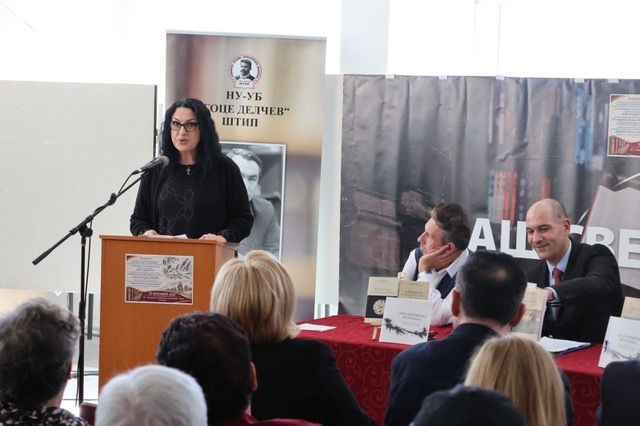
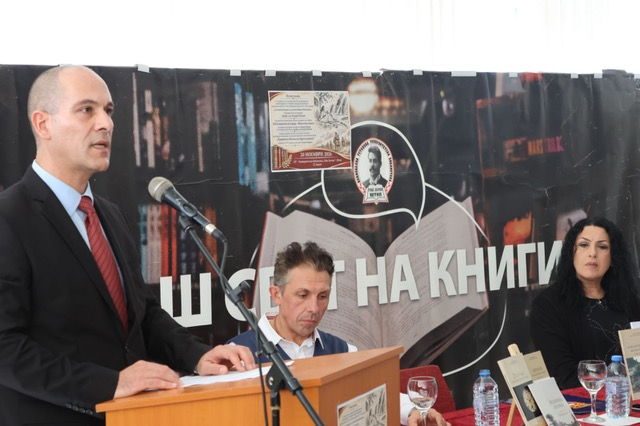
At the “Goce Delcev” National and University Library in Stip, a seven-volume edition dedicated to the Balkan Wars (1912–1913) and the Macedonian Front (1915–1918) was presented. The work was authored by Prof. Dr. Oliver Cackov from the Faculty of Educational Sciences at “Goce Delcev” University in Stip, and Dr. Anita Ilieva-Nikolovska from the Macedonian Academy of Sciences and Arts.
The event also featured the opening of an exhibition titled “(Un)finished History – Visual Records,” which combines original drawings by Jovana Koceva with historical texts by Prof. Dr. Oliver Cackov. Additionally, the short documentary film “The Bloody Battle of Bregalnica”—shot in 1913 by the Russian filmmaker Samson Chernov—was screened for the first time.
According to Prof. Dr. Oliver Cackov, the primary objective of this seven-volume edition—along with an accompanying university textbook—is to present the Macedonian Front as a significant chapter in Macedonian history and to shed light on the fate of the Macedonians who lost their lives in these military conflicts. “This publication aims to present this front as our own—as Macedonian—because historiography maintains, and the facts confirm, that Macedonia gained nothing from it; quite the contrary. The research and facts we have documented should serve as an enduring testament to all those Macedonians who gave their lives, and whose remains still lie scattered across the territory stretching from Belasitsa to Ohrid, and from Krivolak to Ohrid. Sadly, the names of many of them will likely never be known,” noted Tsatskov.
The exhibition “(Un)finished History – Visual Records” seeks to bring this historical perspective closer to the local audience—specifically the residents of Štip—through a visual reconstruction of wartime events and life in the city during the Balkan Wars. Tsatskov points out that few people today are aware of the historical significance of the area surrounding Štip, a place where the interests of the kingdoms of that era converged, and where the clashes of the Battle of Bregalnica began.
“Through this exhibition, using an imaginative depiction, we aim to capture how the people of Štip experienced the war—the uncertainty and the fear—especially those who, from their own windows, were direct witnesses to the unfolding military events,” explains Tsatskov.
The premiere screening of film footage from the Battle of Bregalnica—which, according to Cackov, constitutes exceptionally significant historical material—attracted particular interest. He notes that he spent about ten years searching for it before finally discovering the footage in the State Archives.
The recording, captured by the Russian filmmaker Samson Chernov in 1913, serves as a rare visual testament to the military events that took place in this region over a century ago. Its value is especially high, given that wartime conditions and the censorship of the era severely restricted the filming and documentation of battles.
“For the first time, the people of Štip will have the opportunity to see what the Battle of Bregalnica looked like, through authentic film footage from 113 years ago. This material, alongside the exhibition, serves as a significant visual and historical supplement to our existing knowledge of this subject,” emphasizes Cackov.
The author indicates that the research is ongoing and that the seven-volume edition will not be his final contribution to this field. Future plans include further research and the uncovering of new insights, which will be presented to both the academic community and the general public. “It is important to highlight—especially given the current geopolitical landscape and our European integration process, which should focus on opening negotiation chapters rather than rewriting history—that the two authors have invested a tremendous amount of effort. They have meticulously examined numerous factual and historical documents, many of which had not previously been published in their entirety. In essence, this is a ‘micro-historical’ project. In the field of history, this implies a deep dive into the specifics—explaining the Balkan Wars and their significance, and illustrating how the Macedonian people fought for the interests of others and within foreign armies, rather than for their own interests. Furthermore, I must emphasize that this is of particular importance to us as Macedonians; after all, if we do not know our history, it is bound to repeat itself.
This serves as a stepping stone toward something much larger yet to come—a project centered on the Macedonian Front, specifically the positions around Dojran. It is truly regrettable that we, as Macedonians, do not invest sufficient effort in this regard. One need only look at the Greek side—at the memorial complex they have established, featuring both indoor and outdoor museum exhibits. I believe it is time for us to do the same: to give greater visibility to our history, culture, and language, for this is the legacy that remains with us as Macedonians,” stated Prof. Dr. Andrej Iliev, who presented the seven-volume edition. With this presentation, Prof. Dr. Oliver Cackov and his co-author make a significant contribution to historical research and the promotion of the Macedonian past, weaving together scholarly literature, visual art, and archival film footage into a unified narrative about one of the most significant and tragic historical chapters in this region.