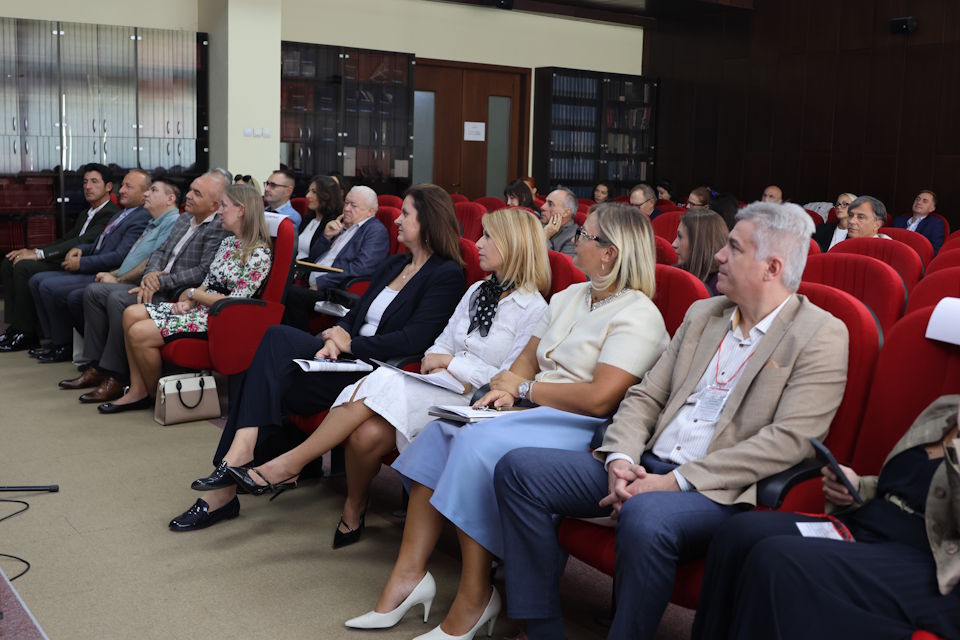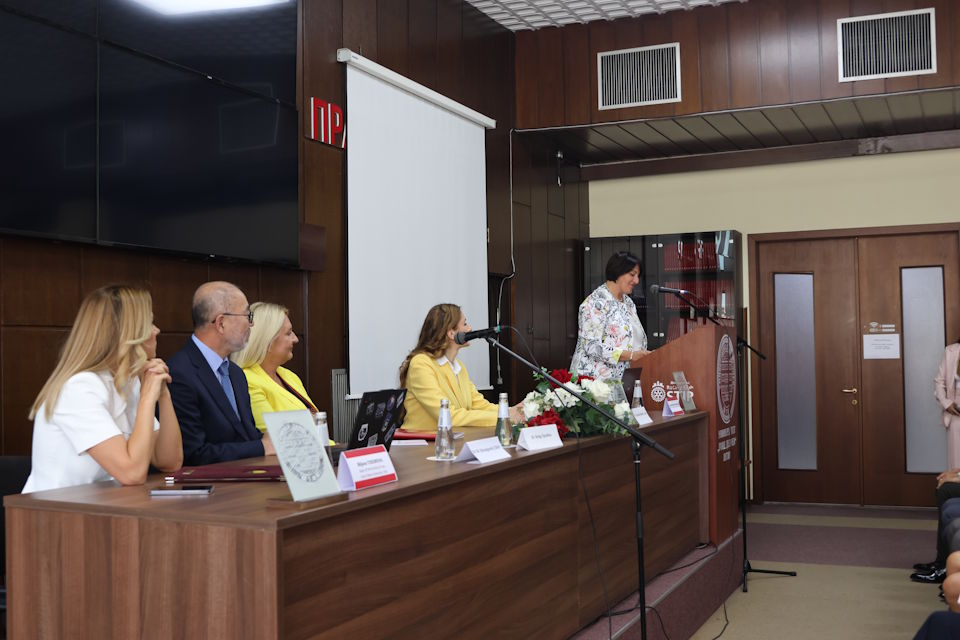
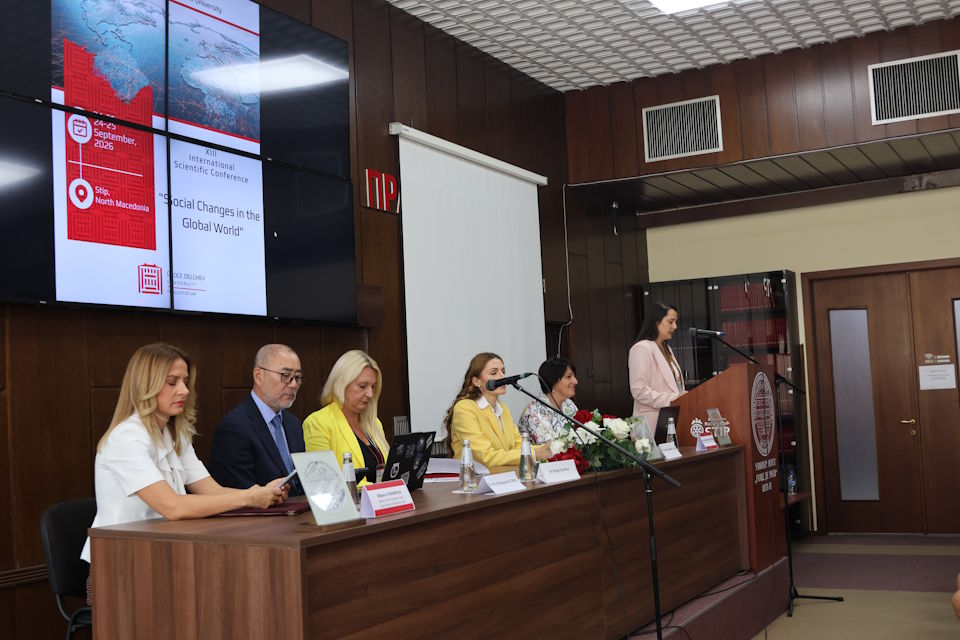
The 13th International Scientific Conference entitled “Social Changes in the Global World” began at the Faculty of Law at the University of Goce Delcev in Stip, which on September 24 and 25 brings together over 100 scientists and researchers from 15 countries around the world.
The opening ceremony was marked by speeches and presentations by top domestic and foreign experts, and the Dean of the Faculty of Law, Prof. Dr. Biljana Todorova, emphasized the importance of the conference:
“It is particularly important for us that this year the conference is a place where different scientific fields, experiences and different perspectives meet. We are particularly pleased to have three keynote speakers with truly topical topics: Professor Jovanka Jakoblek Halalik from the University of Warsaw, Poland, who will speak about the role of law and administrative law in protecting democracy in times of uncertainty; Professor Helga Šmadina from the Faculty of Law of the University of Kosice, who will address artificial intelligence in education and how it can be used as a tool for improving teaching and critical thinking; and our third keynote speaker, Professor Besir Chu from the Ethnic College in the USA, who will speak about international cooperation in the development of curricula for cybercrime investigations and legal education in the age of artificial intelligence.”
Prof. Dr. Todorova added that the topics of this year’s conference are very diversified – from law, human rights and European integration, to artificial intelligence, media and politics, emphasizing that the goal is to understand the changes and convey them to the wider professional public through science and reasoned discussion.
As one of the keynote speakers, Dr. Jovanka Jakubek Lalik, professor at the Faculty of Law and Administration at the University of Warsaw, Poland, emphasized in her address:
“My presentation today is dedicated to the topic of how important public administration and administrative law are for democracy, especially at a time when we are facing a decline in democracy in many countries around the world – in Europe, in the USA and in other regions. Therefore, I asked myself, to what extent can law really save democracy and to what extent can it respond to these kinds of challenges.”
Dr. Helga Špadina, professor at the Faculty of Law at the Josip Juraj Strossmayer University in Osijek, Croatia, also gave her opinion on the long-standing cooperation and contemporary challenges:
“We have been cooperating with the Faculty of Law in Štip for 13 years, both at this conference and in other joint activities such as teacher exchanges, student exchanges, and we are really glad to be part of this conference and to be able to maintain this good cooperation between the Croatian and Macedonian faculties. Today we have two topics. The first topic is related to the use of artificial intelligence as a pedagogical tool in the education of lawyers, and the second topic is related to informed consent and virtual pornography. My personal opinion is that it helps them a lot and that we as teachers must include the tools of artificial intelligence in legal education, but that does not diminish the role of the teacher and my opinion is that the teacher is now more important than ever in any education, especially in the education of lawyers. Today, using examples from the European legal practice, I will show why it is important for us to explain and interpret the legal norm and why only humans can do that, and we cannot leave that part to artificial intelligence. Because it is a very complex process where you have to interpret the legal norm in such a way that you examine how effective it is, how efficient it is, and you have to put it in the context of other legal norms in the system, and artificial intelligence cannot do that.”
Dr. K.C. Cho, associate dean of the School of Social Sciences, Communications and Humanities at Endicott College in Massachusetts, USA, also spoke about the importance of technology and artificial intelligence in the security sector:
“The topic I will be presenting is the use of artificial intelligence related to cybercrime, cybercrime investigations and the application of artificial intelligence in criminal law. An artificial intelligence-based tool can help many investigators and detectives navigate large amounts of data when tracking cybercriminals, transactions related to financial crime and drug trafficking, as well as discovering the ways in which they hide, plan attacks on certain agencies or systems, or cooperate with each other. When investigating a criminal in cyberspace, we need to find out who he is, where he lives, where he has been in the last few months, with whom he has communicated and what information he has exchanged. This is a huge amount of information. Sometimes it takes detectives a lot of time to do this, but artificial intelligence will help us reduce the time and effort invested, as well as direct us towards a more efficient investigation.”
The conference continues its work over these two days through several thematic panels, presentations, and interactive sessions, opening new horizons for scientific collaboration and research.