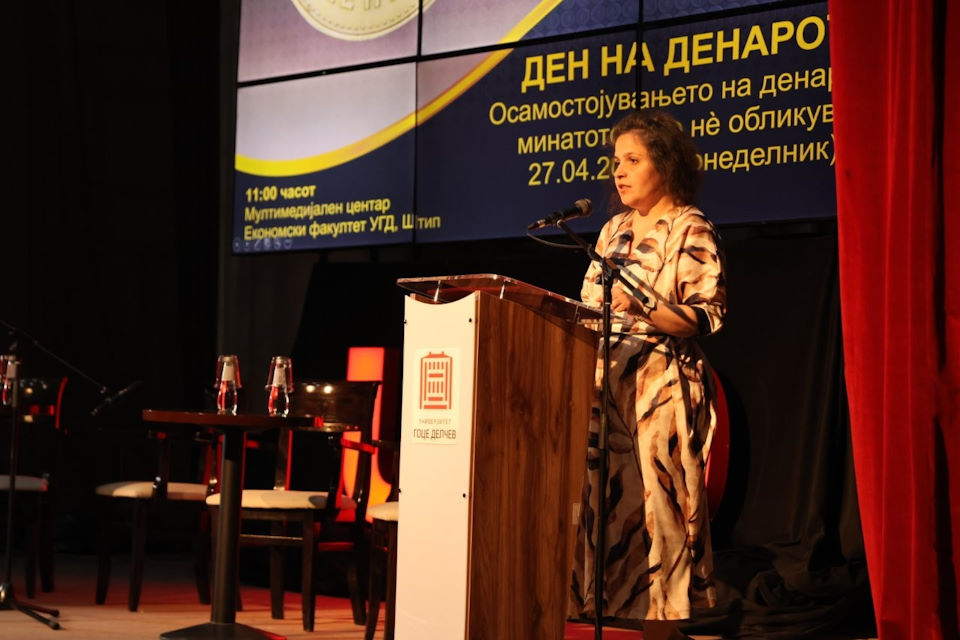
For the fifth time in a row, the Department of Finance at the Faculty of Economics at the University of Gdansk is organizing the event “Denar Day”, in honor of marking 34 years since the independence of the denar as the Macedonian currency.
“I am pleased that the Faculty of Economics marks Denar Day, as one of the most important events in modern Macedonian history, as monetary independence, which, together with all other national symbols in our country, is significant and important in modern history,” said Prof. Dr. Ljupco Davchev.
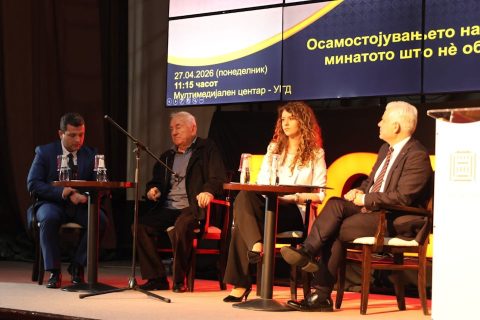
Ljube Trpeski, former governor of the NBRM, is one of the five members of the commission that implemented the project for the introduction of the Macedonian denar, which consisted of the then Prime Minister Kljusev, the then Minister of Finance Toshevski, Governor Stanoevski and Professor Ksente Bogoev, as people from science.
“Those were turbulent times, when we lived in high inflation. Back then, inflation was growing daily, there was an increase in prices like today, which is on an annual basis. Now we get excited when inflation rises from 4 to 5% on an annual basis, and then the currency was devalued daily. In one paper, I wrote that the most important people back then were street dealers, because everyone who received a salary immediately ran to the street dealers to exchange their money for foreign currency, then most often in German marks. We had the courage, we had the knowledge to make a project that was successful – to have a stable currency today and to have money that numismatists consider to be the most beautiful or among the most beautiful money in the world in terms of design and appearance,” said retired professor Ljube Trpeski.
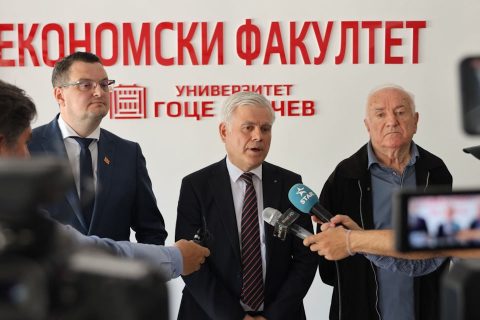
According to him, the stability of the denar has been maintained all these years thanks to the conservative monetary policy, in the most positive sense of the word, implemented by the National Bank throughout this period, as well as to the coordination with the Ministry of Finance, since coordination between monetary and fiscal policy is necessary. Trpeski recalls the historical moments.
“For me, those were the happiest moments. The first day when the shops opened, because it was before the holidays, from April 26 before the May Day holidays, I went out to the markets and rejoiced like a child how the population normally accepted the new money, the Macedonian denars,” recalls Trpeski.
Deputy Minister of Finance, Nikolche Jankulovski, stated that the stability of the national currency is a direct result of the stable policies of the state and the NBRM. According to data from March 2026, an annual growth of 16.3% was recorded in deposits in denars by citizens and 13.3% by the corporate sector.
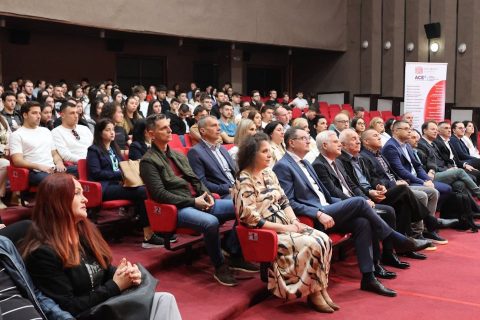
The event was also addressed by the Chief Executive Officer and Chairman of the Board of Directors of NLB Tutunska Banka, MA Toni Stojanovski, who emphasized that this is one of the most significant dates for the modern Macedonian state in terms of economic independence, when this state chose, in addition to the political part, to move forward independently and independently in the economic part.
“Of course, the first years, when we look back, were not easy, with high inflation, still weak institutions, an underdeveloped financial system. However, sometime by 1995, things stabilized and in 1995 the monetary strategy of a de facto fixed exchange rate of the denar was adopted, first against the German mark, and later against the euro. This monetary strategy is still relevant today, having survived for more than three decades. With this monetary strategy, the Macedonian denar passed all the tests of external shocks, crises, internal, external, and was the central part of the macroeconomic stability of our country. Like rarely any other issue, there is a consensus on this strategy among all previous governments, governors, the economic, and political public. Along with that, we also built the banking sector and the financial system as a whole. What we have today – trust in the denar and the banking system is something that gives us solid foundations so that we can focus on the future that is coming.” and to which we need to be open in order for the economy and society to move forward,” said Stojanovski.